|
Main regulations for a physics fight
- In each physics fight, each team has 3 non-penalised tactical rejections and 1 permanent rejection. In the first fight, one more tactical rejection is allowed. After using all the rejections, each additional rejection is stored as permanent and reduces the reporter coefficient on 0.2: 2.8, 2.6, 2.4….
- The penalty coefficient is preserved for the semifinals but resets for the final.
- Each team has a one-minute timeout per physics fight, which can be taken if not interrupting other teams’ monologue.
- If there are 18+ teams, 1st, 6th and 7th teams in the selective fights ranking play one semifinal fight, another one between the teams that ranked 2nd, 5th and 8th, and the third one between the teams that ranked 3rd, 4th and 9th.
- If there are less than 18 teams, one semifinal is held between teams that ranked 2nd, 5th and 6th, the other one between teams that ranked 3rd, 4th and 7th; the 1st team proceeds directly to the final.
- The Opp cannot challenge a problem which a) was permanently rejected by the Rep earlier; b) was presented by the Rep earlier; c) was opposed by the Opp earlier; d) was presented by the Opp earlier. The rules are lifted in the order d), c), b) and a).
- Each team member can make it to the stage only twice for normal fights, and once for the finale.
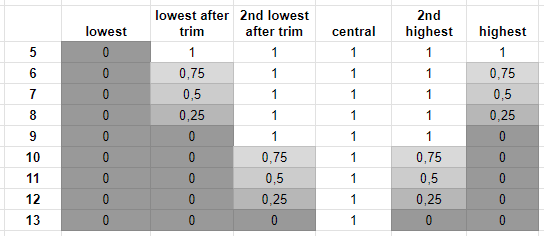
- The final grades for each round for each participant are calculated as a weighted mean, where weights are defined by the table
How to use the platform
- Most of the displayed elements can be clicked on. You can access teams, individual participant or jury member statistics, as well as details of each Round, Physics Fights and Problem.
-
The results are updated once after each round.
In case you spot a bug or have any suggestion to improve the software, please don't hesitate to open an issue
at our repository
or to get in touch with us at execom (a) iptnet (dot) info.
-
Use this tool for
the list of the forbidden problems in a round.
|